The Soybean Miracle of Tian Ye Qin Xue
Campus Action
It All Starts with a Single Soybean!
It All Starts with a Single Soybean!
Soybean Footprints on Campus
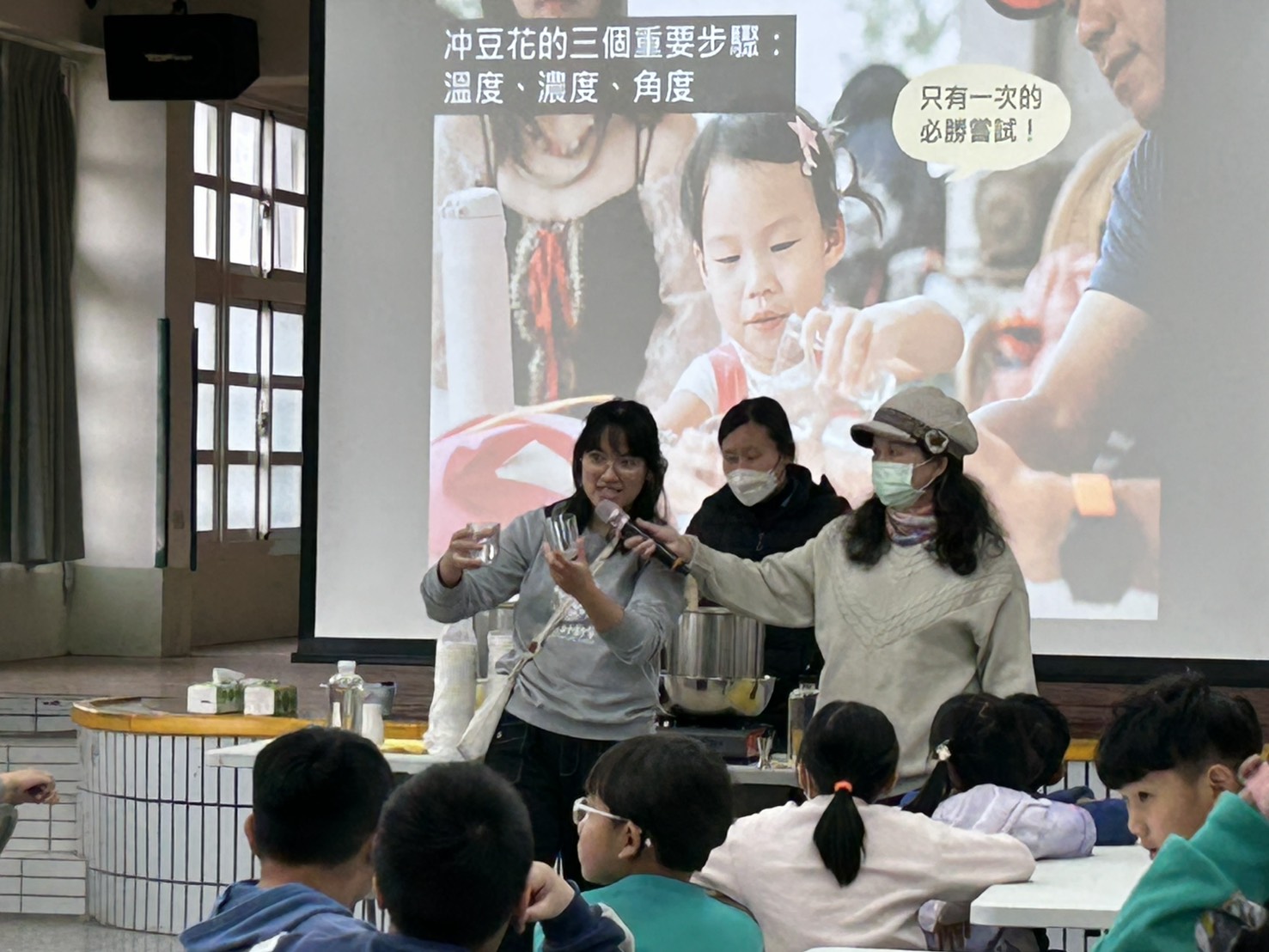
Learning Journey of the Food and Agriculture Course
Ms. Liu Wan-chi from Tian Ye Qin Xue first introduced the organization’s vision, which is built upon three pillars: "Agriculture, Food, and Education." She explained how they promote the sustainable development of domestic soybeans through cultivation, production, and educational services. We learned about "Natural Farming," an eco-friendly approach, and discovered that it takes approximately 90 to 120 days for soybeans to grow from planting to harvest. When the beans are about 80% ripe, they can be harvested as edamame. We also learned how to judge the right time for harvest and were introduced to sowing machinery.
Additionally, we learned about the different varieties of domestic soybeans, which are categorized by the color of their seed coat into yellow and black soybeans. We also got to know specific cultivars developed by regional Agricultural Research and Extension Stations, such as Kaohsiung Selection No. 10, Green Kernel Black Bean, Tainan No. 10, and Hualien No. 1. Following this, we explored a "Soybean Food Map" to recognize the diversity of soy products, including douhua (tofu pudding), tofu, soybean oil, natto, miso, dried tofu, and soy sauce.
Ms. Liu Wan-chi from Tian Ye Qin Xue first introduced the organization’s vision, which is built upon three pillars: "Agriculture, Food, and Education." She explained how they promote the sustainable development of domestic soybeans through cultivation, production, and educational services. We learned about "Natural Farming," an eco-friendly approach, and discovered that it takes approximately 90 to 120 days for soybeans to grow from planting to harvest. When the beans are about 80% ripe, they can be harvested as edamame. We also learned how to judge the right time for harvest and were introduced to sowing machinery.
Additionally, we learned about the different varieties of domestic soybeans, which are categorized by the color of their seed coat into yellow and black soybeans. We also got to know specific cultivars developed by regional Agricultural Research and Extension Stations, such as Kaohsiung Selection No. 10, Green Kernel Black Bean, Tainan No. 10, and Hualien No. 1. Following this, we explored a "Soybean Food Map" to recognize the diversity of soy products, including douhua (tofu pudding), tofu, soybean oil, natto, miso, dried tofu, and soy sauce.
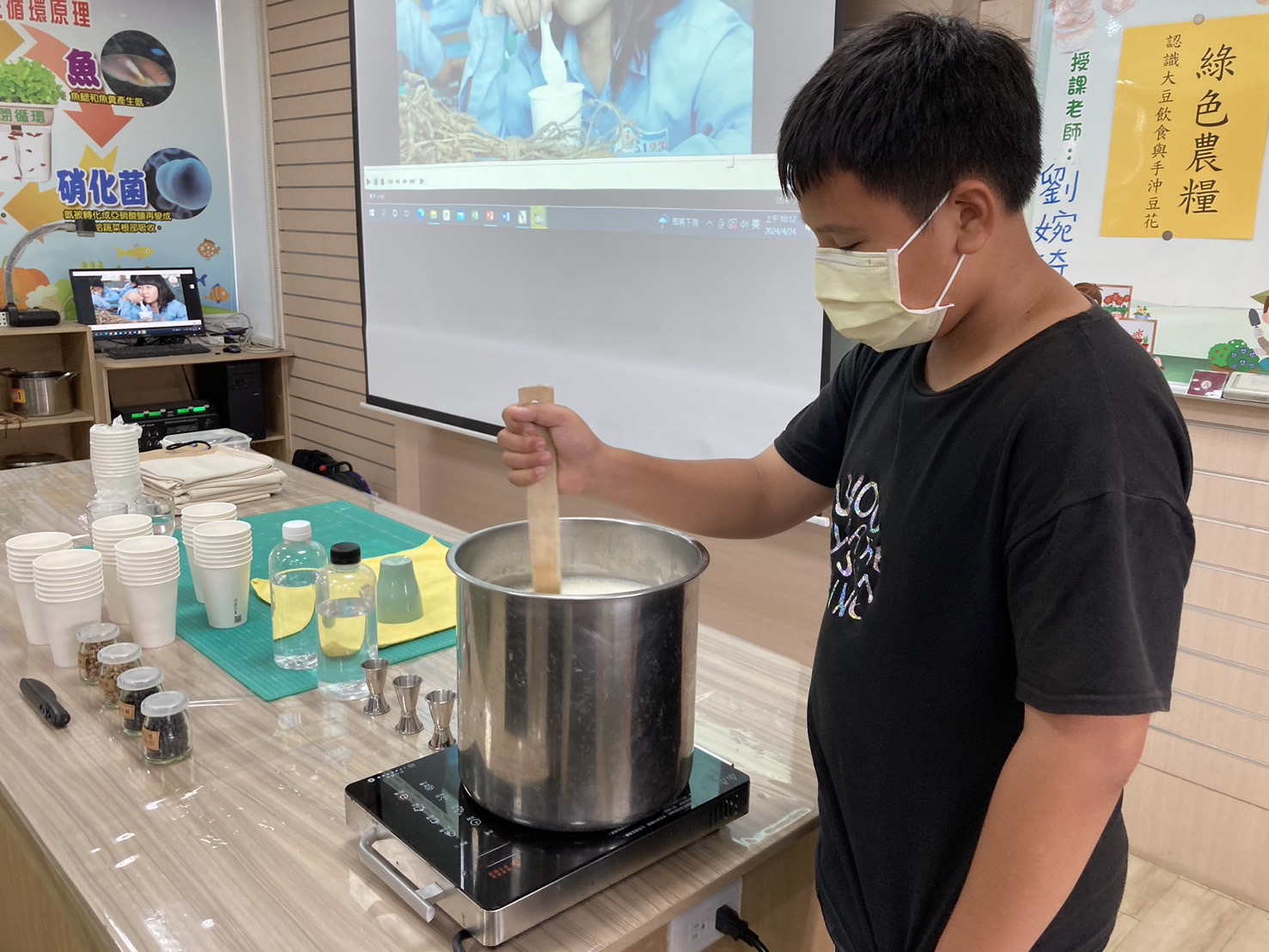
Hand-poured Douhua Experience
First, we took heated soy milk and combined it with water and a coagulant (food-grade gypsum). By mastering the "Three Degrees" principle—Concentration, Temperature, and Angle—we poured the mixture into a container to successfully create our very own bowl of douhua.
First, we took heated soy milk and combined it with water and a coagulant (food-grade gypsum). By mastering the "Three Degrees" principle—Concentration, Temperature, and Angle—we poured the mixture into a container to successfully create our very own bowl of douhua.
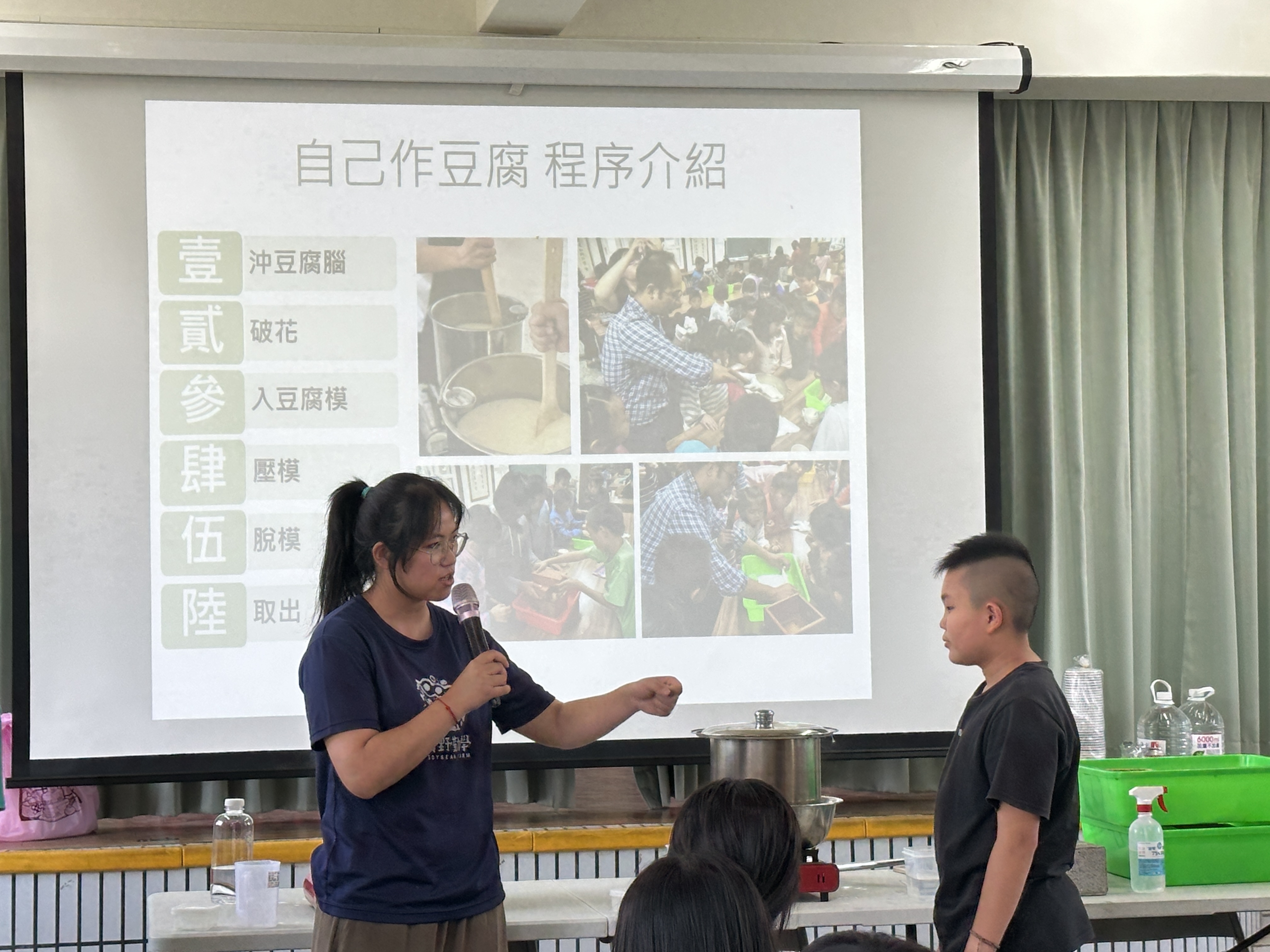
Tofu-making Experience
We began by pouring heated soy milk into a container and waiting quietly for it to curdle into soft "tofu brain" (tofu curds). Next came the process of "breaking the curds" (po-hua), which involves gently stirring the curdled soy milk to turn it into fine, uniform granules. Then, we moved to the "molding" stage: first, we lined a mold with cloth, then poured the tofu curds in and leveled them out. Finally, we performed "pressing." By using weight to slowly squeeze out excess water, the tofu gradually took its solid shape.
This experience reminded us of our interview, where we learned that the most popular products are soy milk and tofu. Regarding the difficulty of production, Mr. Chen Guang-jing shared a common industry saying: "If you can sell soy milk, don't sell tofu; if you can sell tofu, don't sell dried tofu." This is because the production of soy products requires the continuous removal of water, which steadily increases the technical difficulty. Creating these products is a result of refined technique combined with years of experience.
We began by pouring heated soy milk into a container and waiting quietly for it to curdle into soft "tofu brain" (tofu curds). Next came the process of "breaking the curds" (po-hua), which involves gently stirring the curdled soy milk to turn it into fine, uniform granules. Then, we moved to the "molding" stage: first, we lined a mold with cloth, then poured the tofu curds in and leveled them out. Finally, we performed "pressing." By using weight to slowly squeeze out excess water, the tofu gradually took its solid shape.
This experience reminded us of our interview, where we learned that the most popular products are soy milk and tofu. Regarding the difficulty of production, Mr. Chen Guang-jing shared a common industry saying: "If you can sell soy milk, don't sell tofu; if you can sell tofu, don't sell dried tofu." This is because the production of soy products requires the continuous removal of water, which steadily increases the technical difficulty. Creating these products is a result of refined technique combined with years of experience.
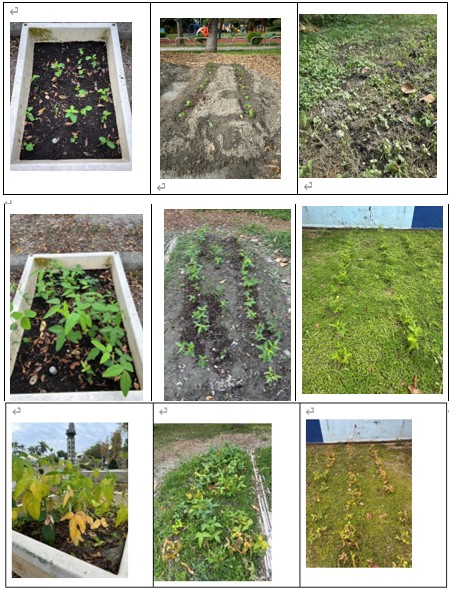
A Full Record of Soybean Cultivation on Campus
Our campus soybean cultivation initiative officially began on October 20th. We personally planted the soybeans that had been soaked the previous day.
Our campus soybean cultivation initiative officially began on October 20th. We personally planted the soybeans that had been soaked the previous day.
- October 27th (2025): The soybeans were moved into planting boxes. Some seeds had already begun to sprout quietly, giving us our first real sense of the "power of life."
- October 30th: We divided the soybeans into three different zones for planting to facilitate our observations of different growing environments.
- November 3rd: The soybeans continued to grow taller and stronger.
- November 13th: Soybeans in all three zones began to develop pods.
- December 5th: The pods remained green; inside were the "edamame" that we are all so familiar with.
- December 12th: The pods became increasingly plump, and the quantity grew.
- December 24th: Some pods began turning yellow or brown, signifying that the soybeans were gradually maturing.
- January 15th (2026): Most pods had turned brown, indicating that the harvest season was near.
- January 23rd: We completed the soybean harvest, bringing a successful conclusion to our campus cultivation journey.
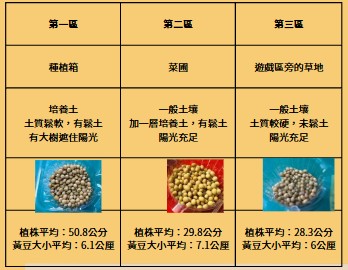
Observation Findings:
Environmental Impact on Growth Performance Our observations revealed that different planting environments significantly affect the growth performance of soybeans.
Zone 1: Potting Soil + Ample Sunlight
Although the soil conditions were superior, the average plant height reached 50.8 cm while the average pod size was 6.1 mm. This suggests that while abundant nutrients promote tall plant growth, they do not necessarily result in the largest pod development.
Zone 2: Mixed Soil (General + Potting Soil) + Ample Sunlight
The average plant height here was 29.8 cm. Despite being shorter in stature, the average pod size reached 7.1 mm—the largest among the three groups. We infer that this specific soil mixture helps balance nutrients, allowing more energy to be directed toward pod development.
Zone 3: General Soil (Near Playground) + Ample Sunlight
This zone consisted of harder soil without any added potting soil. Although it received plenty of sunlight, the average plant height was only 28.3 cm and the average pod size was 6 mm. This group showed the weakest overall growth performance, demonstrating that soil quality plays a critical role in crop development.
Environmental Impact on Growth Performance Our observations revealed that different planting environments significantly affect the growth performance of soybeans.
Zone 1: Potting Soil + Ample Sunlight
Although the soil conditions were superior, the average plant height reached 50.8 cm while the average pod size was 6.1 mm. This suggests that while abundant nutrients promote tall plant growth, they do not necessarily result in the largest pod development.
Zone 2: Mixed Soil (General + Potting Soil) + Ample Sunlight
The average plant height here was 29.8 cm. Despite being shorter in stature, the average pod size reached 7.1 mm—the largest among the three groups. We infer that this specific soil mixture helps balance nutrients, allowing more energy to be directed toward pod development.
Zone 3: General Soil (Near Playground) + Ample Sunlight
This zone consisted of harder soil without any added potting soil. Although it received plenty of sunlight, the average plant height was only 28.3 cm and the average pod size was 6 mm. This group showed the weakest overall growth performance, demonstrating that soil quality plays a critical role in crop development.
Reflections
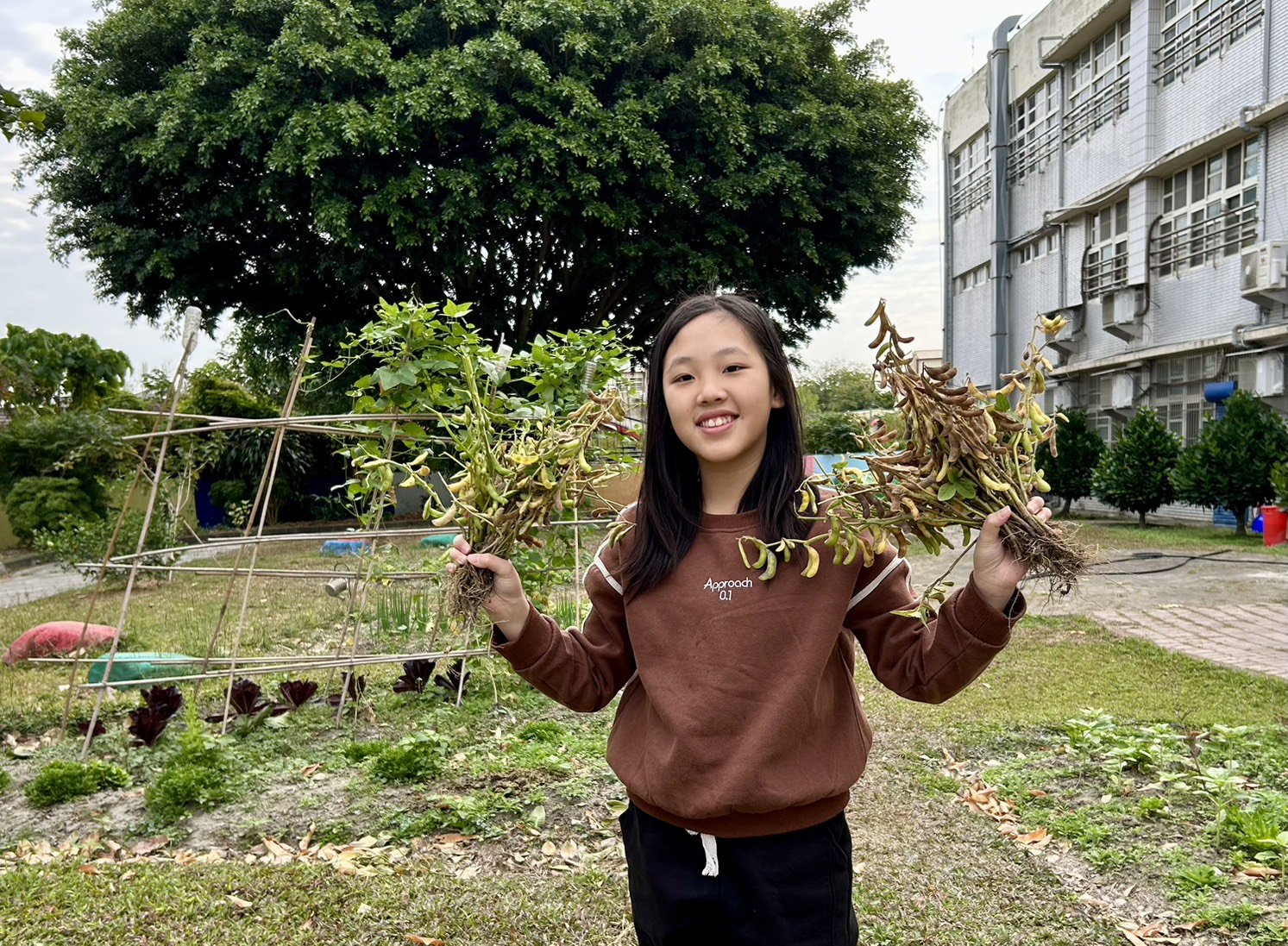
We discovered that the soybeans grown on campus were smaller and less plump compared to those cultivated by Field Learn. Mr. Chen Guang-jing explained to us that soybeans require ample sunlight to thrive. If the sunlight is insufficient, the plants tend to become "leggy" (etiolated), with weak, spindly stems that are prone to collapsing. Furthermore, we learned an interesting technique: when soybeans are nearing maturity, the entire plant can be uprooted, bundled, and hung upside down to allow the beans to finish ripening naturally.
We discovered that the soybeans grown on campus were smaller and less plump compared to those cultivated by Field Learn. Mr. Chen Guang-jing explained to us that soybeans require ample sunlight to thrive. If the sunlight is insufficient, the plants tend to become "leggy" (etiolated), with weak, spindly stems that are prone to collapsing. Furthermore, we learned an interesting technique: when soybeans are nearing maturity, the entire plant can be uprooted, bundled, and hung upside down to allow the beans to finish ripening naturally.
Fude Elementary School, Yongjing Township, Changhua County
Address: No. 36, Fude Lane, Yongjing Township, Changhua County 512
